
When a child assembles, tests, makes mistakes, adjusts and sees a project work, they learn much more than “messing with robots”. She learns to organize thoughts, observe cause and effect, deal with frustration and transform an idea into something concrete. This is the central point of educational robotics: technology is used as a learning tool, not as a distraction.
For many families, doubt usually appears in three forms: “is my child still young?”, “is this just a joke?” and “how to know if the class has pedagogical value?”. The answer depends less on the equipment used and more on the methodology behind the experiment. A good robotics class needs to respect age, propose possible challenges, encourage autonomy and show the child that learning involves trying, reviewing and improving.
At My Robot, robotics is presented as a progressive journey. The child begins with more playful, visual and concrete experiences; then moves on to programming using blocks, sensors, mechanisms, electronics, automation and more complex projects. The goal is not to accelerate childhood. It’s about creating an environment in which curiosity, imagination and reasoning walk together.
Robotics is not just assembly: it is thought in action
The assembly draws attention, but the educational value lies in the process. Before a project can work, the child needs to understand the challenge, observe the pieces, follow or create a sequence, test hypotheses and interpret results. When something doesn't fit, doesn't turn on or doesn't move as expected, she needs to think: is the error in the structure, the control, the sensor, the motor or the sequence?
This type of investigation develops computational thinking naturally. The child learns to divide a problem into smaller parts, recognize patterns, eliminate unnecessary information and organize steps to reach a solution. Instead of memorizing an answer, she learns a way of reasoning.
There is also a relevant emotional gain. In many school activities, mistakes appear as a sign of failure. In robotics, when done well, errors become information. The project that didn't work shows where to investigate. The next attempt is part of the learning. For children, this strengthens persistence, self-confidence, and frustration tolerance.
What changes at each age
Educational robotics needs to accompany the child's maturity. For younger children, the focus should be on motor coordination, sequence, creativity, spatial awareness, cause and effect and simple language. Projects with larger pieces, command cards and playful challenges help children understand technology without relying on screens or complex codes.
As the child grows, projects can include more refined fittings, block programming, motors, sensors, remote control and challenges with greater autonomy. At this stage, she is already able to compare alternatives, plan steps and explain why she chose a certain path. Robotics becomes a bridge between Science, Mathematics, Art, Engineering, History, Geography and everyday life.
From the moment the student gains maturity for more precise projects, mechanical structures, controller boards, Scratch, Arduino, automation and more advanced programming come into play. The important thing is not to skip steps. A strong course doesn't try to impress with complexity too soon. It builds base, security and repertoire.
Benefits that appear inside and outside the class
The first benefit is usually cognitive. The child learns to reason in stages, observe relationships, anticipate consequences and review decisions. This speaks directly to math, science, and reading problems.
The second is behavioral. Robotics projects require concentration, care with materials, time organization and responsibility for the process itself. The child realizes that it is not enough to have a good idea: it is necessary to execute it with method.
The third is socio-emotional. In many classes, students need to communicate what they did, listen to suggestions, share resources and learn from solutions different from their own. This encourages collaboration, empathy and respect for the rhythm of colleagues.
The room is creative. Robotics should not be a cold sequence of commands. Children need to imagine solutions, adapt structures and personalize projects. Creativity, here, is not just “inventing anything”. It's creating with intention, within real limits.
How to know if your child is ready
The child does not need to arrive knowing how to assemble robots, program or enjoy technology intensely. Curiosity is already a good starting point. Asking how things work, enjoying building, showing interest in games, machines, animals, cities, stories or challenges can already indicate an openness to this type of learning.
More important than “already knowing” is having an environment that welcomes different rhythms. Some children participate quickly. Others observe before acting. Some talk a lot about the project; others show interest more silently. A good instructor can notice these signs, guide without asking the child and propose questions that help the student advance.
What to observe in the Trial Class
The Trial Class is a consultative step. Its value lies in getting to know the prospective student, observing how they participate, understand challenges, test possibilities and learn, and then recommending the most suitable track.
It is also worth observing the instructor's approach. Do they provide ready-made answers or help the student think? Do the work for the child or offer clues? Respect the individual pace? Explain to the family which skills were engaged?
The recommendation should consider continuity: where to begin, which skills to develop and how projects progress through the next modules. This way, the decision is not based only on whether the child enjoyed one isolated activity.
Robotics as an intelligent use of technology
Many parents pursue robotics because they want to reduce passive screen use. This concern makes sense, but the best answer is not to treat all technology as the enemy. The point is to change the child's position: from consumer to creator.
When she puts together a project, programs a sequence, adjusts a sensor or presents a solution, technology stops being a ready-made stimulus and becomes language. The child learns that they can use digital resources to build, investigate and solve problems. This change in posture is one of the greatest benefits of educational robotics.
How to choose a consistent proposal
A good school must clearly explain what the student learns, how they learn and why that content makes sense for their age. There must be methodology, monitoring, security, adequate material and progressive challenges.
Be wary of exaggerated promises. Children's robotics need not promise to produce precocious engineers, professional programmers or technology geniuses. The value is in developing solid foundations: logical thinking, creativity, autonomy, organization, communication and confidence to learn.
In the end, the most useful question is not whether robotics is too soon. The right question is whether the child is having real opportunities to create, think, experiment and evolve in a meaningful way. When the answer is still no, educational robotics can be a much better start than it seems.
Next learning paths
If this topic made sense for your family, these tracks help turn curiosity into practical projects.

Firstbot
For ages 5 to 7, with playful, concrete and guided first steps in robotics.
View course
Onebot
Building and block-based programming to develop logic, autonomy and applied creativity.
View course
Skillbot
Robotics challenges with more strategy, decision-making and problem solving.
View courseProducts to keep exploring at home
These Maker Store options match the article topic and help turn curiosity into hands-on projects.
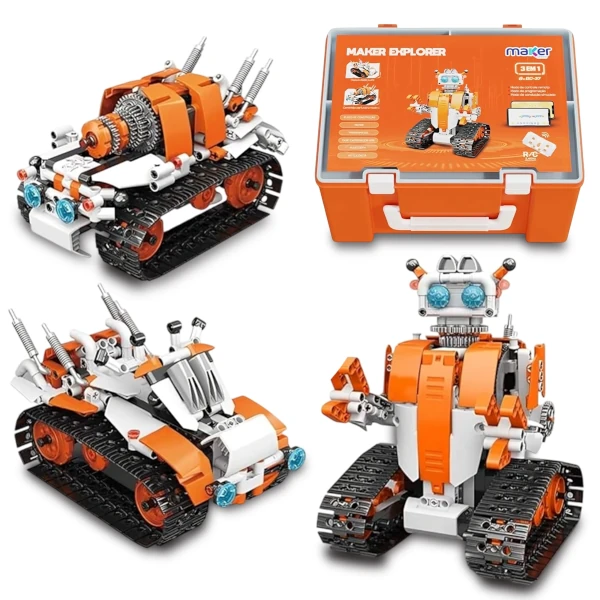
Maker Explorer 3-in-1 Robotics Kit
A practical entry point for building, observing movement and turning curiosity into creation.
View in Maker Store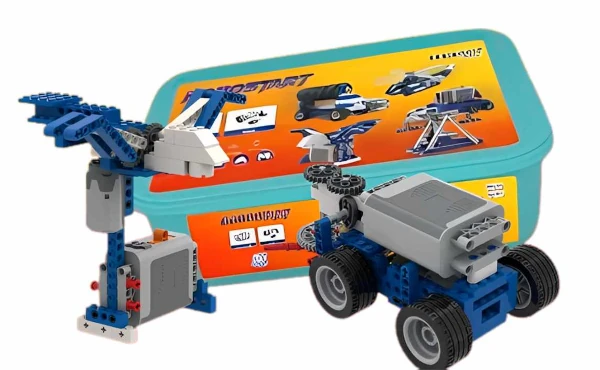
Robostart 50-in-1 Kit
Combines building blocks and varied challenges to develop persistence, repertoire and logical reasoning.
View in Maker Store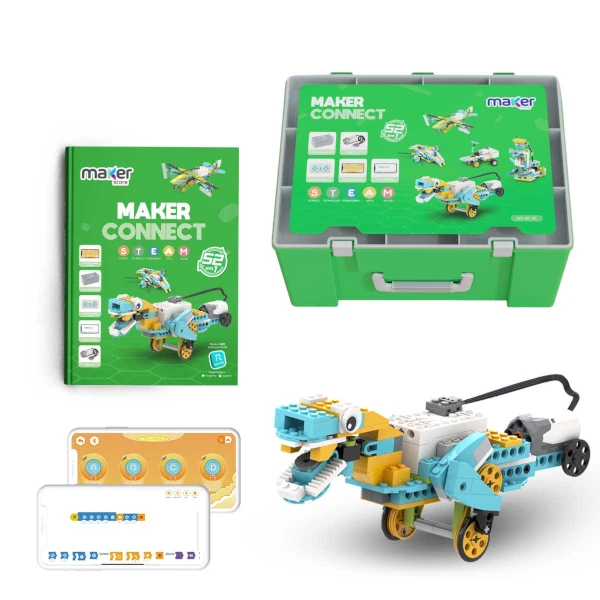
Maker Connect 52-in-1 Kit
Expands building possibilities and encourages children to test different solutions.
View in Maker StoreAffiliate links: when you buy through these links, you support My Robot Barra da Tijuca.
Want to see technology in practice?
At My Robot Barra da Tijuca, children and teens learn technology by creating projects, testing ideas and developing autonomy.