

Discover robotics through safe building pieces, playful challenges, and command cards that make learning hands-on and fun.
5 to 7 yearsRecommended age
Up to 2 hoursClass duration
In personMy Robot Barra da Tijuca
1 class per weekFrequency
Portuguese and EnglishClass languages
First contact with technology
In Firstbot, children learn by playing and building with large, colorful and safe pieces. Command cards introduce logic and sequence without relying on screens.
The proposal is to make robotics something close, fun and understandable. Instead of just watching, the child assembles, tests, observes and realizes that they can create with their own hands.
Important skills for this phase
- Logical sequence and first notions of programming.
- Fine motor coordination and spatial perception.
- Creativity, curiosity and applied imagination.
- Autonomy to assemble, test and adjust projects.
- Confidence to learn through trial, error and discovery.
Worked pillars
Learn by doing
Screenless logic
Command cards help children understand sequence, cause and effect, and decision making in a concrete way.
Active construction
Assembling is a central part of the process. The child truly participates and sees the project take shape before them.
Topics close to everyday life
Nature, animals, culture and everyday discoveries appear in the projects and help keep interest high.
Autonomy with support
The student learns with close monitoring, but is already starting to make small decisions about assembly and solutions.
What are the classes like?
Short and practical classes
Each class presents a concept in a simple way, followed by a practical challenge that invites the child to build and experiment. The focus is not on memorizing difficult terms, but on understanding through experience.
Throughout the course, the child becomes familiar with rules, commands, assembly and solving small challenges in a safe and stimulating progression.
Projects and experiences
What the child experiences in Firstbot
First projects
The initial activities help the child understand assembly, fitting, movement and sequence of commands in an accessible and concrete way.
World exploration
The projects connect to themes such as nature, animals, culture and everyday situations, expanding repertoire and curiosity.
Examples of constructions
Scales, castle, mining company, robot dog, boat, snake and mammoth are some of the projects that make learning memorable.
Pedagogical progression
The course evolves gradually, allowing the child to gain confidence before moving on to more advanced trails.
Video
See in practice
To delve deeper
Related reading
Blog content that talks about initial robotics, practical learning, predictability and child development.
 Related reading
Educational robotics for kids: real benefits, right age and how to start
Understand how educational robotics develops logical reasoning, creativity, autonomy and confidence, and see what to observe in an trial class.
Read article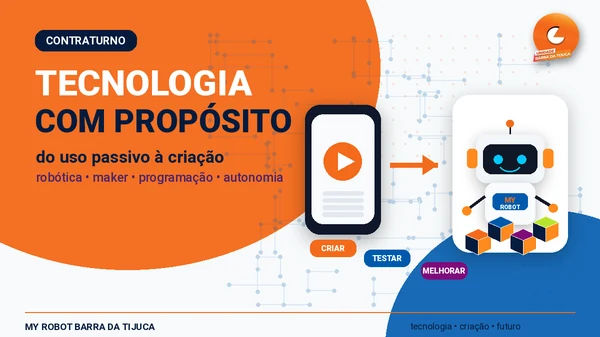 Related reading
Technology with purpose after school: how to choose an extracurricular activity that really develops
See how to choose extracurricular technology, maker and robotics activities that reduce the passive use of screens and develop autonomy, logic and creativity.
Read article
Next step
Does Firstbot suit your child?
During the Trial Class, we get to know the prospective student and observe age, interests, prior experience and learning style to recommend the most suitable track. It is an individual guidance step for the family, not a one-off class or promotion.