
We live in an era marked by accelerated digital transformation.
Technologies such as artificial intelligence, automation and the Internet of Things are already part of everyday life and will profoundly shape the future of work and society.
In this context, an essential question arises for parents and educators: how to prepare children for this new world?
Educational robotics has stood out as one of the most complete answers. More than teaching technology, it develops cognitive, socio-emotional and practical skills that are fundamental for the 21st century.
1. Development of logical and computational thinking
Teaching robotics is, first and foremost, teaching how to think. When assembling and programming a robot, the child needs to organize ideas in a logical sequence, identify problems, propose solutions, test, make mistakes and correct the path.
These processes are directly linked to computational thinking, recognized as one of the essential skills by the National Common Curricular Base.
Furthermore, robotics courses work with active methodologies and practical learning.
In more advanced tracks, such as Techbot, students apply Physics, Mathematics and Engineering concepts to real projects, developing logical reasoning and autonomy in problem solving.
2. Practical and meaningful learning
Unlike traditional teaching, robotics places the student as the protagonist. The child learns by doing, sees the results of what they have built and understands in practice concepts that might seem abstract in other contexts.
- Learn by doing
- See the immediate results of what you have built
- Understand abstract concepts in practice
This approach is aligned with methodologies such as STEAM, which integrate Science, Technology, Engineering, Arts and Mathematics.
In initial courses, such as Firstbot, learning takes place in a playful way, with larger pieces and accessible challenges that awaken curiosity and creativity from an early age.
3. Development of socio-emotional skills
Robotics doesn't just develop technical skills. It also forms people. During classes, children work as a team, face challenges, deal with mistakes and learn to communicate their ideas more clearly.
This process strengthens skills such as:
- Resilience, by learning from trial and error
- Teamwork, through collaboration on projects
- Communication, when explaining ideas and solutions
- Autonomy, when making decisions and assuming responsibilities
Studies and educational experiences show that robotics activities also promote inclusion, social interaction and cooperation in different environments.
4. Preparation for your professional future
Professions linked to technology are among the fastest growing in Brasil and in the world. When children learn robotics, they come into contact with fundamentals that are part of this transformation.
- Programming
- Electronics
- Automation
- Engineering
In more advanced courses, such as Autobot, students already have contact with platforms such as Arduino, used in real technology and industrial projects.
This doesn't mean that all children will become programmers, but it does mean that they will be more prepared for an increasingly technological world.
5. Stimulating creativity and innovation
Robotics combines logic with creativity. Each project is an opportunity for the child to imagine solutions, test different paths and transform ideas into something concrete.
In Onebot, for example, students are encouraged to create their own projects, without relying solely on a rigid step-by-step guide. This develops creative thinking, a repertoire to innovate and the confidence to experiment.
In the 21st century, this ability to create new solutions is an important differentiator, both in the professional field and in everyday life.
6. Integration with other areas of knowledge
Robotics is interdisciplinary in nature. It connects different areas and makes school learning more alive, interesting and applicable.
- Mathematics, with calculations and logic
- Physics, with movement, force and energy
- Sciences, with observation and experimentation
- History and Geography, when contextualizing real projects and problems
In Skillbot, for example, challenges and projects can address conscious consumption, energy, decision making and critical reasoning, connecting theory and practice in a more meaningful way.
Conclusion
Teaching robotics to children is not just a trend. It's a necessity.
Robotics:
- Develops logical and critical thinking
- Stimulates creativity and autonomy
- Strengthens socio-emotional skills
- Prepare for your professional future
- Makes learning more meaningful
In an increasingly technological world, providing this type of education is giving children not only knowledge, but tools to build their own future.
References and bases used
- Common National Curriculum Base (BNCC)
- Brasileiro Support Service for Micro and Small Businesses (SEBRAE) - Educational technologies for socio-emotional development
- Brasileiro Support Service for Micro and Small Businesses (SEBRAE) - Competency-based teaching
Courses to transform educational robotics into real development
If the idea is to start a technology journey with purpose, these trails help the child to develop logic, creativity, autonomy and confidence progressively.

Firstbot
For children aged 5 to 7, start with robotics in a playful way, motor coordination and first logical sequences.
Discover the course
Onebot
To advance in construction, block programming and projects that stimulate autonomy, repertoire and creativity.
Discover the course
Skillbot
For more elaborate challenges, decision making, critical thinking and problem solving in robotics projects.
Discover the courseMaker Store products to continue exploring at home
For families who want to bring their child closer to robotics outside of class, these products help stimulate assembly, logic, creativity and practical experimentation.
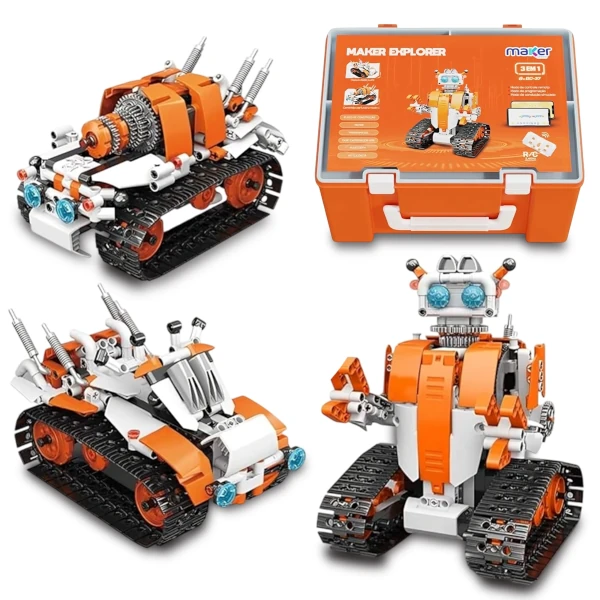
Maker Explorer 3-in-1 Robotics Kit
An entry option to assemble, observe movement and transform curiosity into concrete creation.
View on Maker Store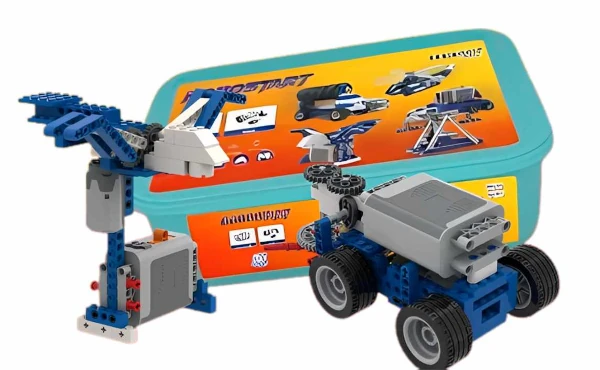
Robotstart 50 in 1 Kit
It combines building blocks and varied challenges to develop persistence, repertoire and logical reasoning.
View on Maker Store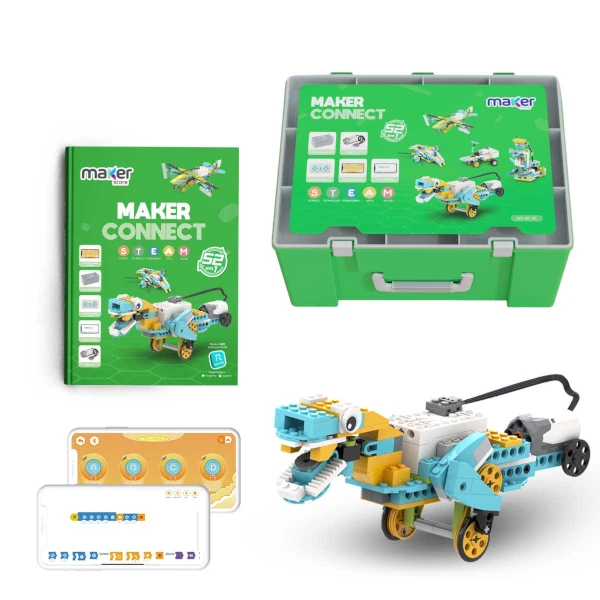
Maker Connect 52 in 1 Kit
Recommended to expand assembly possibilities and encourage children to test different solutions.
View on Maker StoreAffiliate links: by purchasing through these links, you support My Robot Barra da Tijuca.
Want to see this happen in practice?
At My Robot Barra da Tijuca, children and teenagers experience technology in a progressive, creative and hands-on way. If you want to understand which trail makes the most sense for your family, talk to our team.