
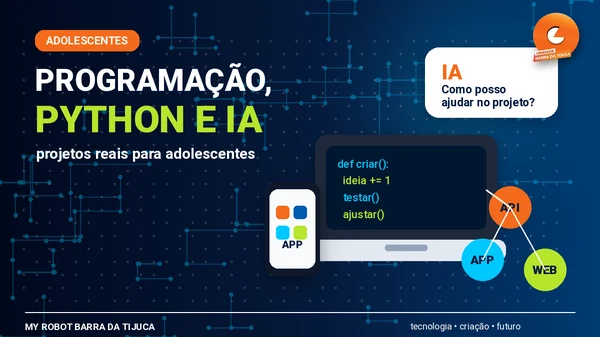
Many teenagers are already surrounded by games, applications, videos, social networks and artificial intelligence tools. The question for families is not whether technology will be part of their lives. This is already happening. The question is whether they will just be users or whether they will also learn to create, interpret and make decisions with technology.
A good programming course for teenagers should not start by promising a career, salary or immediate mastery of complex tools. It needs to start with the essentials: teaching young people to think in stages, understand problems, write instructions, test hypotheses and build projects that make sense for their age and interests.
Python, application creation and artificial intelligence are very strong paths when there is a base. These are current, attractive and useful themes. But, without methodology, they can just become impactful words. The value appears when the teenager understands what they are creating and can explain how they arrived at the result.
Programming is learning to organize thought
Programming is not just writing code. It's transforming an idea into a logical sequence that a machine can execute. To do this, the student needs to break down the challenge, identify patterns, define conditions, deal with errors and improve the functioning of the project.
This process develops logical reasoning, attention, persistence and clarity of communication. The teenager learns that an ambiguous instruction generates a wrong result. You also learn that small changes can alter the entire behavior of a system. This requires care, analysis and responsibility.
Therefore, programming is valuable even for those who do not intend to pursue a career in technology. It teaches a way of thinking that helps with studies, projects, presentations and everyday decisions.
Why Python often makes sense for young people
Python is a language known for its more readable syntax and for its application in different areas, such as automation, data analysis, artificial intelligence, web development and prototyping. For teenagers, this is interesting because it allows them to see practical results without starting with an excessive technical barrier.
But Python should not be treated as a “magic shortcut”. The student needs to understand variables, decision structures, repetition, functions, libraries, APIs and operating logic. When this path is progressive, language becomes a powerful tool for getting ideas off paper.
In AI projects, for example, Python may appear in the creation of chatbots, text generators, querying APIs and simple systems that respond to commands. The teenager realizes that code is not something abstract: it interacts with services, data, interfaces and users.
Artificial intelligence requires discretion, not enchantment
Artificial intelligence attracts attention because it delivers quick responses and creates texts, images, codes and ideas with apparent ease. In education, however, the most important question is not “what does the AI answer?”, but “how does the student evaluate, question and use that answer?”.
A serious AI course for teenagers needs to work on critical thinking. The student must understand differences between traditional and generative AI, limits of tools, importance of data, risks of inaccurate answers, privacy, authorship and responsible use. You also need to learn how to formulate good prompts, interpret results and connect AI to real projects.
Application creation: when the idea becomes an experience for someone
Creating an app is an especially engaging experience for teens because it connects technology to real problems. The student needs to think about user, objective, screen, flow, functionality, usability, data and presentation. He stops doing an isolated exercise and starts creating a solution that someone could use.
This type of project develops logic and also communication. An app needs to be explained. Adolescents learn to justify choices, prioritize resources and think about what is essential. You often find that the best solution is not the most feature-packed, but the clearest and most useful.
Creating apps also helps bring design programming, visual organization, planning and idea validation closer together. It is a natural bridge between creativity and method.
What parents should look out for on a course
The first point is progression. Does the course start at an appropriate level or does it already throw the teenager into complex tools with no basis? Is there a path between visual programming, logic, textual language, projects and real applications?
The second is guided practice. Does the student create something or just watch explanations? Does it test, correct, improve and present? A strong course needs to generate concrete experience.
The third is attitude towards error. In programming, error is part of the process. Young people need to learn to read messages, investigate causes and correct them calmly. If the environment turns mistakes into shame, it loses part of its pedagogical value.
The fourth is ethics and responsibility. In AI, data and applications, the student must learn that technology impacts people. Security, privacy, clarity and accountability need to be part of the conversation.
Does a teenager need to really like technology to start?
Not necessarily. Interest helps, but it doesn't have to be technical. Some young people arrive because of games. Others want to create apps. Others are curious about AI, robotics or automation. The role of the course is to transform this initial interest into repertoire.
It's also common for teenagers to discover preferences along the way. One may like logic and algorithms more. Another may identify with interface design. Another might be interested in AI, data, or automation. A well-structured trail allows this discovery without requiring an early decision.
Programming as training for the future
The future will not require everyone to be a programmer, but it will require more and more people to understand how digital systems influence work, study, communication and decision making. In this sense, programming is expanded technological literacy.
Teenagers who learn to create with technology begin to see the digital world with more criteria. He understands that apps, games and tools do not “appear ready-made”. They were planned, programmed, tested and adjusted by someone. This perception changes the relationship with digital consumption.
When is it worth starting
It's worth starting when the teenager shows curiosity and finds a proposal compatible with his maturity. For some, entry may be through games and block programming. For others, by Python, AI, applications, or advanced robotics. The most important thing is that the course generates a real challenge, without losing follow-up.
When programming, Python, AI and apps are taught methodically, the student doesn't just learn to use modern tools. Ele aprende a pensar com mais clareza, criar com mais autonomia e transformar interesses em projetos concretos. This is the type of technological training that follows well beyond adolescence.
Next learning paths
If this topic made sense for your family, these tracks help turn curiosity into practical projects.

Gamebot
Game programming to turn interest in games into logic and digital creation.
View courseProducts to keep exploring at home
These Maker Store options match the article topic and help turn curiosity into hands-on projects.
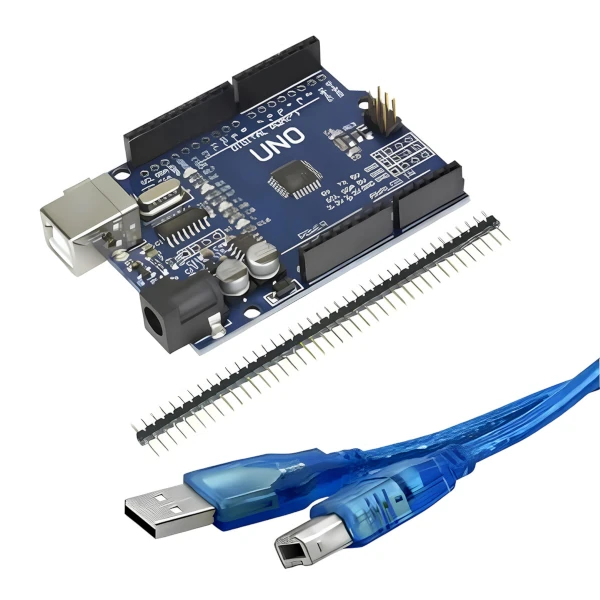
Arduino Uno R3 compatible board
An accessible base for connecting programming, inputs, outputs and physical experiments.
View in Maker Store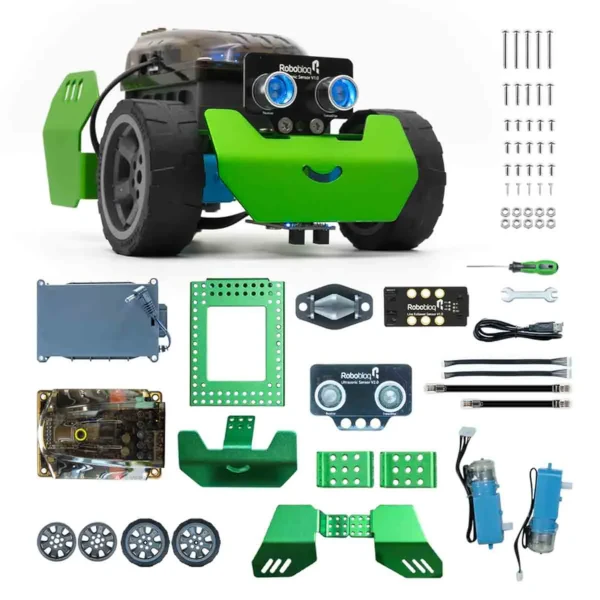
Maker Store Arduino Kit
Useful for exploring sensors, automation and first physical computing projects.
View in Maker Store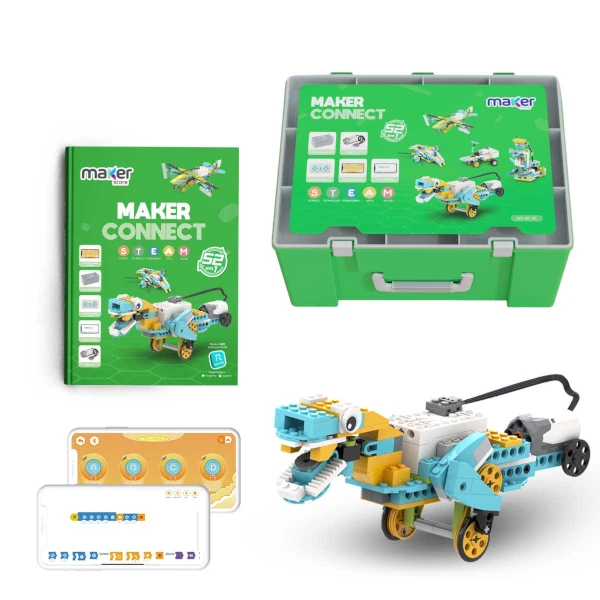
Maker Connect 52-in-1 Kit
Expands building possibilities and encourages children to test different solutions.
View in Maker StoreAffiliate links: when you buy through these links, you support My Robot Barra da Tijuca.
Want to see technology in practice?
At My Robot Barra da Tijuca, children and teens learn technology by creating projects, testing ideas and developing autonomy.