
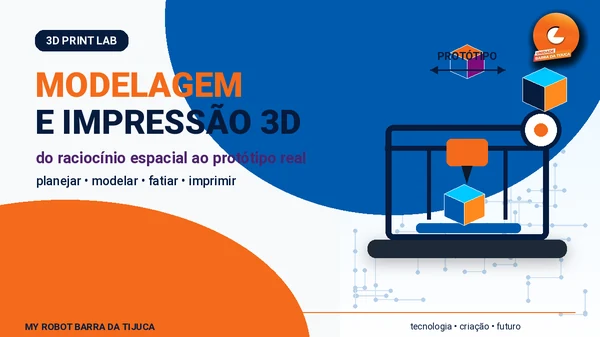
Few experiences show the difference between consuming technology and creating with technology as well as transforming an idea into a physical object. In 3D modeling and printing, the student is not just in front of a screen. He plans, designs, adjusts, prepares and monitors the materialization of a project.
This process has educational value because it combines imagination, spatial reasoning, mathematics, aesthetics, engineering and patience. The child or teenager needs to think about shape, proportion, fit, resistance, function and finish. The result does not appear instantly: it requires steps.
Therefore, 3D printing should not be presented simply as a “machine that makes objects”. The most important point is not seeing the printer working. It's understanding how an idea turns into a model, how the model needs to be prepared for printing and how the project can be improved.
What 3D modeling really teaches
Modeling in 3D requires seeing beyond the plane. The student needs to imagine height, width, depth, volume, symmetry, fits and proportions. This exercise strengthens spatial reasoning, an important skill for areas such as design, engineering, architecture, games, robotics and visual arts.
At the same time, modeling works on planning. Before creating, the student needs to decide what they want to build, what shapes will be used and how each part relates to the whole. If the part needs to fit, rotate, support, support or move, the design requires even more analysis.
There is also a criterion gain. Not everything that looks good on screen works well as a physical object. Thickness, stability, base, strength and proportion matter. The student learns that good ideas need to respect real limits.
3D printing is not just entertainment
3D printing is usually enchanting because it delivers a concrete object. But the pedagogical value appears when the student understands the complete process. It models, prepares, slices, evaluates printing time, observes possible failures and learns how to improve.
At 3D Print Lab, the course works on modeling and 3D printing with theoretical and practical content, organized into modules. The proposal involves free and accessible software, such as Tinkercad for modeling and Cura for slicing, as well as projects that include objects, games, useful parts, supports, fittings and mechanisms.
This structure helps the student realize that 3D printing is not just about “making souvenirs”. It can be used to prototype solutions, organize objects, test ideas, create mechanical parts and materialize concepts.
Why this experience makes sense for teens
In adolescence, 3D modeling takes on a special dimension because it speaks to autonomy, identity and project. The student can now make aesthetic decisions, think about usefulness, analyze references and defend their choices.
For teenagers interested in design, games, architecture, engineering, robotics or product creation, 3D modeling opens an important door. It shows that the screen can be a space for creation, not just for consumption. A character, a piece, a support or a prototype stops being just an idea and starts to take shape.
It is also an activity that develops persistence. 3D projects almost always require adjustments. A part may be fragile, too big, too small, difficult to print, or unsuitable for its intended function. Learning to revise is an essential part of the process.
And for children?
For children, contact with 3D printing needs to be age-appropriate and always accompanied. The focus should be on exploring shapes, creativity, spatial awareness and a simple understanding of cause and effect. The child can understand that an object has parts, dimensions and construction steps, without needing to master all the technical aspects.
The care is to not transform the experience into machine operation. 3D printers require supervision, safety and guidance. The child must participate in the process of creation and understanding, while technical handling is handled responsibly by the instructor.
When well guided, the experience is very rich. The child realizes that an idea can leave the drawing, become a digital model and then a physical object. This strengthens confidence and expands creative repertoire.
Skills developed in the process
The first skill is spatial reasoning. The student learns to visualize objects in three dimensions, predict fits and understand relationships between parts.
The second is applied creativity. Unlike imagining freely, modeling requires viable choices. The student needs to adapt their idea to the tools and limits of the project.
The third is planning. A printed object depends on order, preparation and review. The student learns that poorly resolved steps affect the result.
The fourth is problem solving. If a part doesn't fit, breaks or doesn't print well, you need to investigate the reason and propose adjustments.
The fifth is communication. 3D projects become even more valuable when the student can explain what they created, why they created it and how they would improve the next version.
The role of methodology
Without a methodology, 3D printing can become just a technological demonstration. The child sees a machine working, is enchanted for a few minutes and takes an object home, but learns little about the process.
With methodology, the student understands the concept, creates a project, tests possibilities, organizes steps and receives progressive challenges. Technology stops being a spectacle and becomes a tool for building knowledge.
This alignment is important to maintain coherence with the My Robot proposal: active learning, practical projects, creativity, autonomy and skills development. The printer does not replace the student's reasoning. It makes the result of this reasoning visible.
How parents can evaluate a good experience
Ask if the student models or just receives ready-made files. Check whether there is an explanation about slicing, preparation and print limits. Observe whether the projects evolve in complexity and whether the student is encouraged to improve their ideas.
It is also worth asking what type of project will be developed. Decorative pieces can be interesting, but a complete journey must include useful objects, fittings, structures, mechanisms, and design challenges.
Outro sinal positivo é quando o curso conecta modelagem 3D a outras áreas, como robótica, games, física, engenharia e organização do cotidiano. This shows that the tool is not isolated.
The learning that remains
The best result of 3D modeling and printing is not just the final object. It's the change of posture. The student starts to see problems in a more concrete way: “how could I create a piece to solve this?”, “what shape would be better?”, “how to improve this fit?”, “what do I need to adjust?”.
For families looking for a smarter relationship with technology, this is a consistent path. 3D modeling teaches that good ideas need form, method and revision. And 3D printing shows, in a very concrete way, that thinking well can transform the world around us.
Next learning paths
If this topic made sense for your family, these tracks help turn curiosity into practical projects.
3D Print Lab
3D modeling, prototyping and printing to develop planning and spatial reasoning.
View courseProducts to keep exploring at home
These Maker Store options match the article topic and help turn curiosity into hands-on projects.
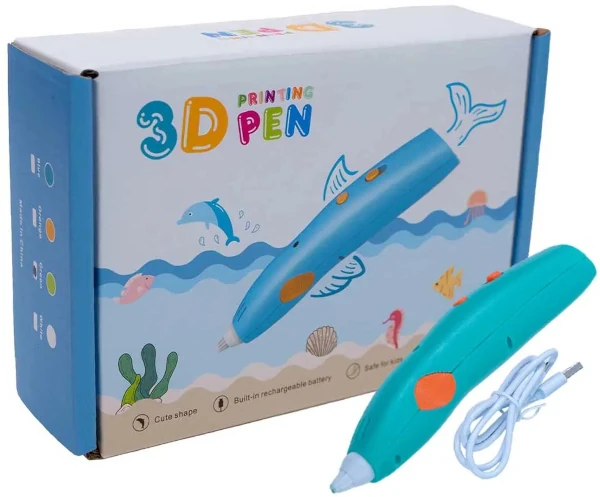
3D Printing Pen with filament and molds
Helps turn ideas into objects while encouraging creativity, coordination and prototyping.
View in Maker Store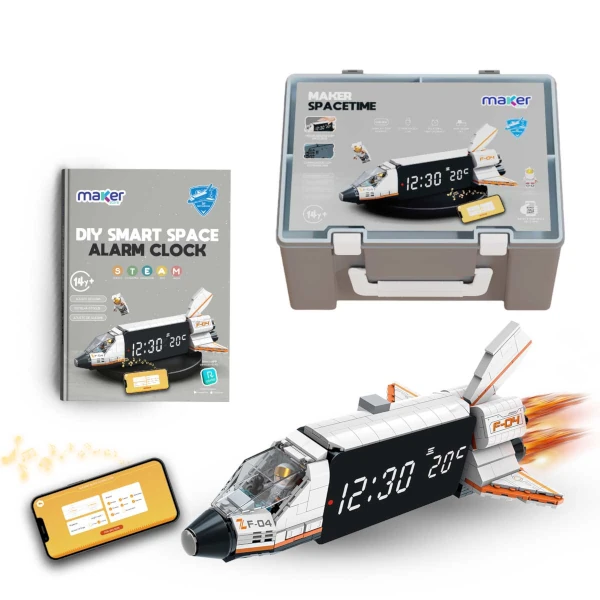
Maker Spacetime Kit
A themed option for exploring imagination, space and creative building projects.
View in Maker Store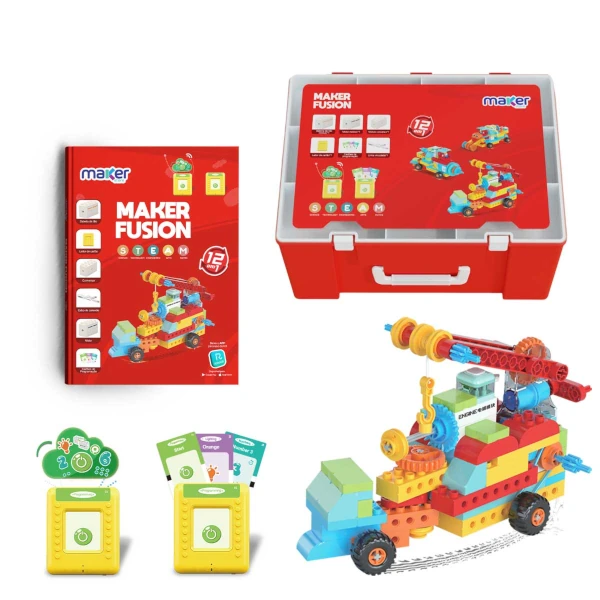
Maker Fusion 12-in-1 Kit
Building projects that organize steps, attention to detail and hands-on experimentation.
View in Maker StoreAffiliate links: when you buy through these links, you support My Robot Barra da Tijuca.
Want to see technology in practice?
At My Robot Barra da Tijuca, children and teens learn technology by creating projects, testing ideas and developing autonomy.