
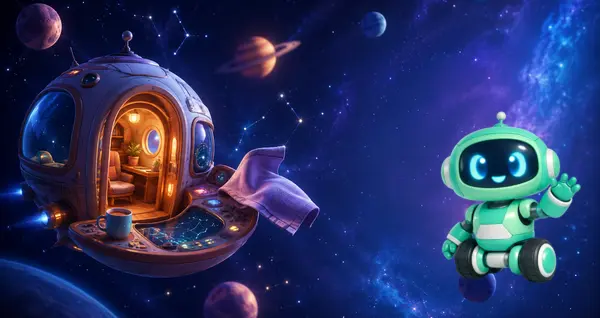
There is a well-known phrase among science fiction fans: “Don’t panic.”
It appears prominently in the universe of The Hitchhiker's Guide to the Galaxy, a work created by Douglas Adams, one of the most curious, intelligent and humorous stories in geek culture.
The first book was published in 1979, after being born as a BBC radio series in 1978, and mixes science fiction, absurd humor, philosophy, technology and a question that crosses generations: after all, what is the meaning of life, the universe and everything else?
In the story, a supercomputer called Deep Thinker is tasked with finding the great answer to “life, the universe and everything else”.
After millions of years of calculation, he finally reveals the answer: 42. The problem is that no one knew exactly what the question was.
And perhaps that's exactly where this story fits so well with My Robot School's proposal.
Because, in the real world, especially when we talk about education, technology, artificial intelligence, robotics and programming, the ready answer is not always the most important thing.
The most important thing is to learn to think, investigate, test, make mistakes, adjust and ask better questions.
Before the answer comes the question
In Douglas Adams' fiction, the number 42 became a fun symbol of the human search for definitive answers. We want to solve everything with a simple formula, a magic number, a shortcut.
But the work's joke itself shows the opposite: there's no point in having an answer if we don't yet know how to formulate the question well.
In educational robotics, this happens all the time.
When a student builds a robot and it doesn't walk, the first reaction may be to think that “it went wrong”. But, within a good methodology, this error becomes a starting point for new questions:
- Is the engine connected correctly?
- Is the code sending the right command?
- Is the structure too heavy?
- Is the sensor reading the environment as it should?
- Is the problem in the assembly, logic or programming?
This process is much more powerful than simply receiving the teacher's response. It is here that the child develops logical reasoning, autonomy, critical thinking and the ability to solve problems.
The My Robot methodology precisely values this active learning, with playfulness, action, autonomy, project construction, creativity and technology.
It also works on hard skills, such as programming logic and robotics concepts, along with soft skills, such as motor coordination, computational thinking, empathy, organization and communication.
The towel: the symbol of preparation
In The Hitchhiker's Guide to the Galaxy, the towel is described as an essential item for any intergalactic traveler.
Therefore, fans of Douglas Adams celebrate Towel Day on May 25th, carrying a towel as a tribute to the author and his work.
It may seem like just a geek joke, but there is an interesting message here: those who are prepared can deal better with the unexpected.
And educating a child for the future is a bit like that.
We don't know exactly what professions will exist in a few years. We don't know which technologies will dominate.
We don't know which artificial intelligence tools will be present in everyday life when our children are adults.
But we know that they will need to develop some essential skills: creativity, logical reasoning, communication, autonomy, critical thinking, collaboration and the ability to continually learn.
The 21st century student’s “towel” is not an object. It's a set of skills.
- It's knowing how to think before acting.
- It's knowing how to test a hypothesis.
- It's knowing how to work as a team.
- It’s knowing how to transform an idea into a project.
- It's knowing how to use technology with purpose.
- It's knowing not to panic when faced with a new problem.
The Deep Thinker and Artificial Intelligence
The Deep Thinker, in the work of Douglas Adams, is a brilliant play on our expectation that computers are capable of delivering great truths.
Today, living in the era of artificial intelligence, this discussion has become even more current.
We have tools capable of generating texts, images, codes, ideas, preliminary diagnoses, plans and solutions. But this does not eliminate the need for human thought. On the contrary: it makes this need even greater.
A child who learns programming, robotics and AI is not just learning to “use a computer”.
She is learning to understand how systems work, how commands produce results, how data influences responses, and how technology can be used to create solutions.
This type of learning helps students move from the position of a passive consumer of technology to a more active stance: that of someone who understands, questions, creates and improves.
“Don’t panic” is also a skill
When a project doesn't work, when the code has errors, when the robot doesn't respond, when 3D printing fails, when the game doesn't perform as expected, there is a silent competence being developed: persistence.
In adult life, problems rarely come with a complete manual.
At work, in studies, in relationships and in everyday challenges, those who can observe, divide the problem into smaller parts and test solutions tend to deal better with complex situations.
This is computational thinking.
In the My Robot methodology, this thinking appears in stages such as decomposition, abstraction, pattern recognition and algorithm creation: dividing the challenge into smaller parts, identifying what is essential, noticing similarities and organizing a sequence of steps to solve the problem.
In other words: the child learns that difficulty is not a sign of failure. It's part of the process.
The universe is big. Curiosity needs to be greater.
One of the beauties of The Hitchhiker's Guide to the Galaxy is showing human beings faced with an immense, strange universe full of unexpected situations.
Arthur Dent, the main character, is thrown into an absurd adventure without being prepared for almost anything.
In technology education, we want the opposite.
We want our students to look at an increasingly technological world without fear.
That they understand that robots, algorithms, sensors, programming, artificial intelligence and 3D printing are not distant things, reserved only for specialists.
They are languages of the present and the future.
And the earlier a child has contact with these languages, in a way appropriate to their age, the more natural their relationship with technology becomes.
Not for everyone to become engineers, programmers or scientists. But so that everyone has the repertoire, autonomy and confidence to live in a world where technology will be increasingly present.
The real answer is not 42
Perhaps the biggest lesson is this: the answer to our children's future is not a magic number.
It's not 42. It's not memorizing commands. It's not just learning how to use a tool. It's not about repeating ready-made answers.
The real answer lies in developing children and teenagers capable of thinking, creating, questioning, collaborating and transforming ideas into real projects.
At My Robot School, educational robotics is a way to make this happen in practice.
Each assembly, each code, each test, each error and each adjustment helps the student to build not just a robot, but a more intelligent, creative and confident way of seeing the world.
Because the future may even seem like a huge galaxy full of questions.
But, with method, creativity, technology and a good dose of curiosity, our students learn to travel through it without panicking.
And, of course, always knowing where your towel is.
Courses for those who want to create, ask questions better and prototype ideas
If the article talks about curiosity, artificial intelligence, programming and trial and error, these trails help the student to get out of passive consumption and put ideas into work.
3D Print Lab
To take ideas from digital and materialize prototypes, developing creativity, planning and spatial reasoning.
Discover the courseProducts for small technology explorers
To match the climate of curiosity, space, better questions and prototyping, these products bring imagination, digital creation and concrete experimentation together.
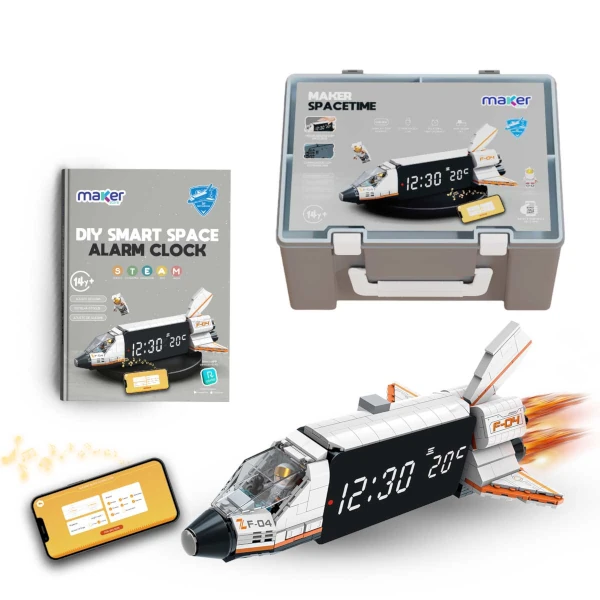
Spacetime Maker Kit
A themed choice for kids fascinated by space, exploration and imaginative maker projects.
View on Maker Store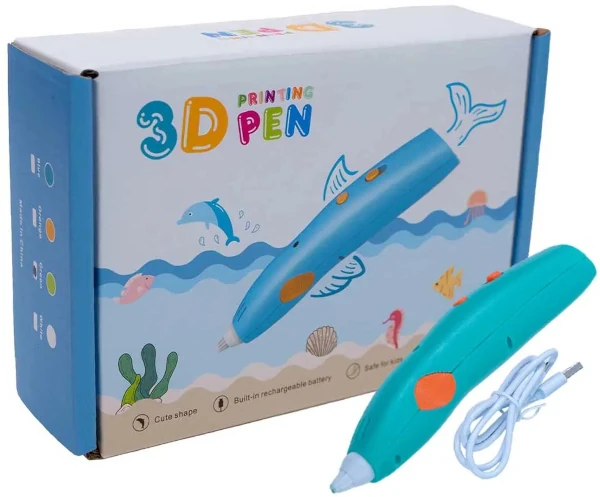
3D Printer Pen with Filament and Molds
It helps transform ideas into objects, stimulating creativity, coordination, planning and prototyping.
View on Maker Store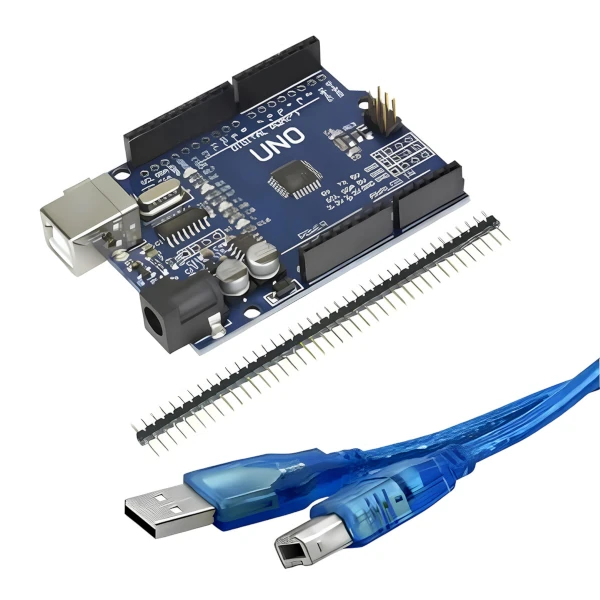
Board compatible with Arduino Uno R3
For young people curious about physical programming, automation and how digital commands generate real-world effects.
View on Maker StoreAffiliate links: by purchasing through these links, you support My Robot Barra da Tijuca.