

Use Arduino, electronics, and sensors to build automated systems that respond to the real world.
12+ yearsRecommended age
Up to 2 hoursClass duration
In personMy Robot Barra da Tijuca
1 class per weekFrequency
Portuguese and EnglishClass languages
From code to system
In Autobot, students understand how sensors, LEDs, displays, motors, and other electronic components connect to Arduino to create functional, intelligent systems.
The course increases autonomy in programming and helps the student to understand, in practice, the relationship between digital commands and physical responses in the real world.
What develops
- Logical reasoning and computational thinking.
- Practical notions of electronics and automation.
- Autonomy in programming with Arduino.
- Planning, organization and responsibility.
- Ability to analyze and solve real problems.
Worked pillars
From component to working system
Components and assembly
The student organizes sensors, LEDs, displays, motors and other components to assemble functional circuits.
Sensors and responses
The projects show how information captured by a sensor can generate action in the physical world.
Logic and programming
The student creates, interprets and adjusts codes, understanding how they affect the assembled system.
Technical autonomy
Challenges encourage decision making, error analysis and gradual improvement of the solution.
What are the classes like?
Concept, circuit and test
AutoBot classes are practical and progressive. The student knows an electronics or programming concept, assembles the circuit, writes or adjusts the code and tests the project's operation.
Along the way, he increasingly understands how hardware and software depend on each other to generate consistent technological responses.
Applications
Projects and themes
Reference projects
Morse code, color generator, 7-segment display, potentiometer play and ultrasonic sensor show the track progression.
System reading and response
The student understands how sensors capture information and how Arduino processes commands to generate actions in the physical world.
Circuits and automation
Analog inputs, PWM, libraries and component integration appear in a practical and contextualized way.
Base for new creations
The course strengthens a more mature view of technology, engineering and the development of functional solutions.
Video
See in practice
To delve deeper
Related reading
AutoBot brings students closer to Arduino, sensors and automation; These contents connect this practice to the future of technology and the logic behind the systems.
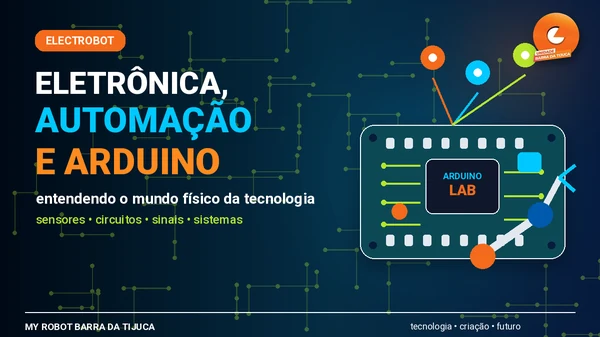 Related reading
Electronics, automation and Arduino for young people: when students begin to understand the physical world of technology
See how electronics, automation, sensors, circuits and Arduino develop logical reasoning, problem solving and practical understanding of technology.
Read article
Next step
Does Autobot suit your child?
During the Trial Class, we get to know the prospective student and observe age, interests, prior experience and learning style to recommend the most suitable track. It is an individual guidance step for the family, not a one-off class or promotion.